
Navigation
- Intro
- Understanding Traditional RAG’s Limitations
- Knowledge is Not Flat. It is a Graph.
- What Actually Changes with Graph RAG
- Why This Matters for Enterprise Use Cases
- When to Use Graph RAG (and When Not To)
- The Tradeoffs
- The Plot Thickens: Bridgerton Demo
- Try It Yourself
- What’s Next for Graph RAG
- Outro
TL;DR
- Traditional RAG retrieves text similarity
- Graph RAG retrieves relationships
- Use Graph RAG when reasoning depends on connections, not just content
Intro
Do we really need Graph RAG?
Short answer: sometimes yes. But only when your problem actually requires it.
Understanding Traditional RAG’s Limitations
Classic RAG works through four steps:
- Break documents into chunks
- Embed them
- Retrieve top-K chunks
- Generate answers
👉 This works for simple retrieval
But fails when relationships matter.
Knowledge is Not Flat. It is a Graph.
Humans think in:
- entities
- relationships
- cause and effect
- hierarchies
Graph RAG makes this explicit.
👉 Retrieval becomes:
connected knowledge instead of similar text
What Actually Changes with Graph RAG
1. Retrieval Becomes Relational
You retrieve:
- paths
- neighborhoods
- subgraphs
2. Context Becomes Coherent
The model sees relationships first
3. Reasoning Becomes Grounded
Connections are already structured
Why This Matters for Enterprise Use Cases
Graph RAG is useful in:
- compliance
- enterprise systems
- healthcare
- legal reasoning
- knowledge bases
When to Use Graph RAG (and When Not To)
✅ Use Graph RAG
- multi-hop reasoning
- identity resolution
- dependencies matter
❌ Use Traditional RAG
- simple lookups
- semantic search
- fast setup
The Tradeoffs
Graph RAG:
- more setup
- more structure
Traditional RAG:
- faster
- simpler
The Plot Thickens: Bridgerton Demo
To make this real, I built a demo.
Question:
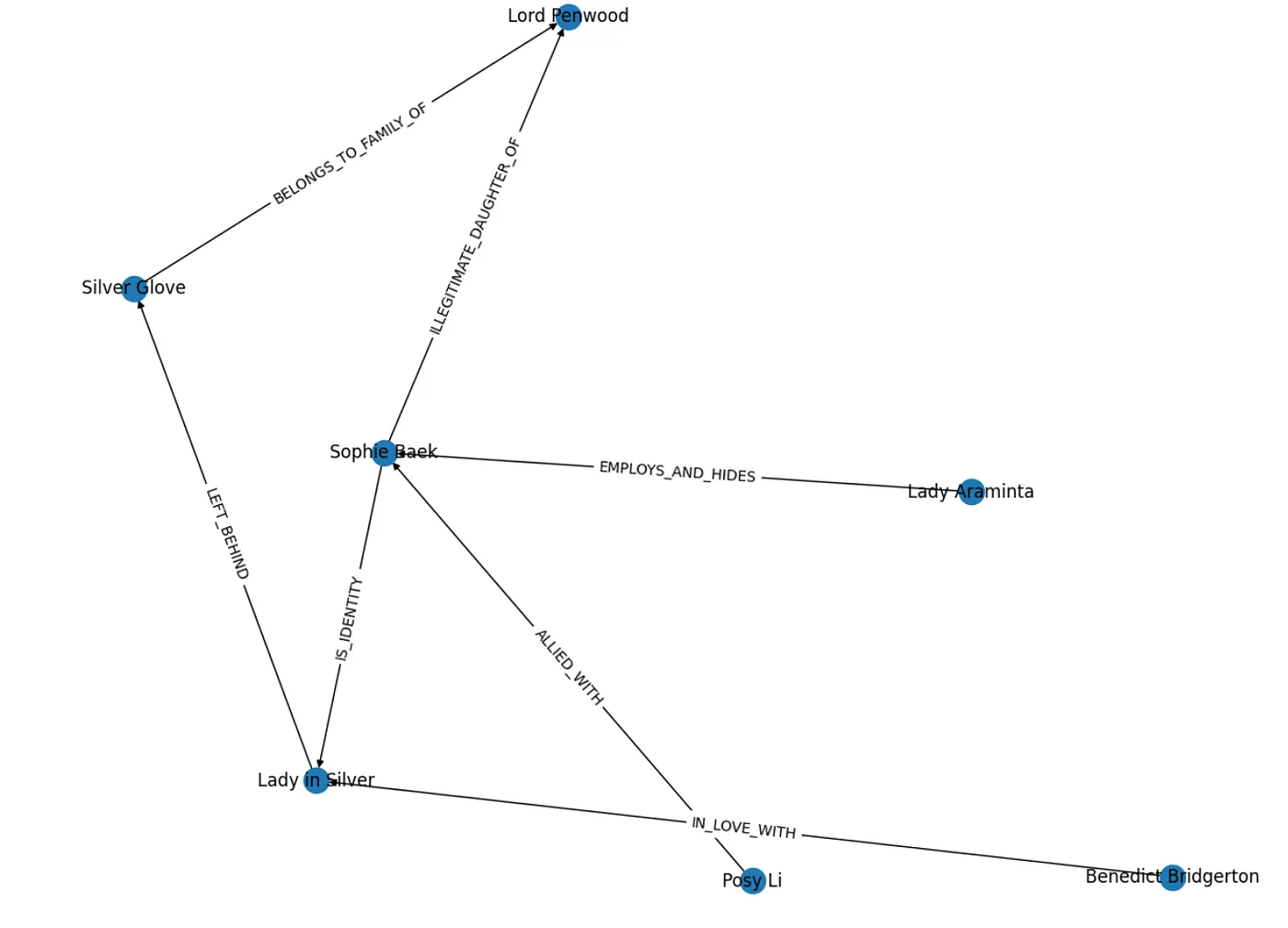
Who is the Lady in Silver, and how is she connected to Lord Penwood?
📸 Scenario Image (Gemini)

Traditional RAG
- retrieves similar chunks
- finds references
👉 Conclusion:
Lady Araminta = Lady in Silver
👉 Sounds correct
👉 Actually wrong
📸 Traditional RAG Output

Graph RAG
- retrieves relationships
- identifies correct entity
👉 Result:
Correct answer + reasoning
📸 Knowledge Graph
🎥 Full Demo Video
Try It Yourself
I built a local demo:
https://github.com/lulu3202/graph-rag-bridgerton-demo
- runs locally
- no API cost
What’s Next for Graph RAG
Still evolving:
- scalability
- ontology design
- hybrid retrieval
Outro
Graph RAG is not replacing RAG.
👉 It’s evolving it.
Key Insight
Traditional RAG retrieves text
Graph RAG retrieves meaning
TL;DR (Again)
- RAG = text
- Graph RAG = relationships
- Use it when structure matters
📩 Subscribe
If you’re building AI systems:
I share practical workflows, tools, and experiments every time I publish.